How-To Geek
How to Convert a Hard Drive or Flash Drive from FAT32 to NTFS Format

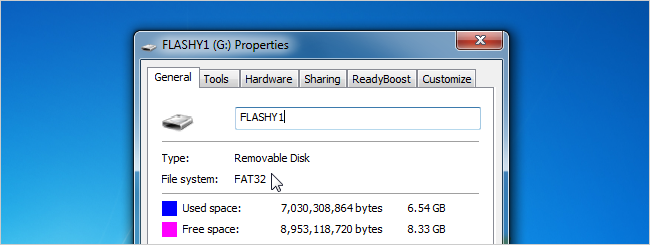
If you’ve got a hard drive formatted with the FAT32 file system, you might have found that you can’t copy large files to that drive. So how do you fix that, and convert the file system over to NTFS? Here’s how.
Scratching your head? Here’s the deal: the FAT32 file system, which most external drives are still shipped with, can’t handle files larger than about 4 GB in size—which means most full-length movies and anything really large, like a virtual machine. If you do try and copy a file, you’ll get an error just like this one:


It’s worth noting that FAT32 works just fine on just about any OS, but NTFS is usually read-only on Linux or Mac OS X.
Convert the File System Directly
If you’ve already got a ton of files on the drive and don’t have the free space to move them around, you can convert the file system directly from FAT32 to NTFS. Just open up an Administrator mode command prompt by right-clicking and choosing Run as Administrator, and then you can type convert /? to see the syntax for the convert command.


In our example, the drive letter is G: so the command we’d use is this:
convert G: /FS:NTFS
The conversion process might take a while, especially if you’ve got a really large drive.


It’s pretty simple, right?
Option 2: Reformat the Drive
If you don’t have a ton of data on the drive, the best bet is to copy any data from the drive to somewhere else, reformat the drive, and then copy the data back. All you have to do is right-click on the drive and choose Format.


And then select NTFS in the file system drop-down.


Finish the format, and copy your data back. Nice and easy.
Got Feedback? Join the discussion at discuss.howtogeek.com
Comments (27)
Programmer by day, geek by night, The Geek, also known as Lowell Heddings, spends all his free time bringing you fresh geekery on a daily basis. You can follow him on Google+ if you'd like.
- Published 04/14/11


Oh wow I never knew about Option 1
! Option 1, lik it :) very clever !!
Why not use XFAT it allows you to copy large files, but still keeps the accessability of a FAT drive?
SC
That’s too cool! I never knew option 1 was there, which is why i haven’t converted my external yet. will try now.
This is great informaiton, but a follow up article on how this is cool, BUT
1. Converting a flash drive back to fat32 is troublesome and software to do it is hard to find.
2. Some flash drive apps do not play well with NTFS – roboform in particular and the company will not support its software on a flash drive that is NTFS (recently enjoyed this process).
3. Until vendors move to NTFS for flash drives, there should be cautions, as reformatting a flash drive is a cumbersome process especially if you use it as a technician like I do. I wanted the health, speed, and reliability of NTFS, but many vendors when they found out my flash drive was NTFS refused to support their software. In my particular case it took almost 6+ hours to put my flash drive back (64gb) to fat32 – this time includes backing up, and restoring.
Most linux distros now enable NTFS read/write by default. There might still be a few stragglers out there, but the ones that don’t, it is most likely a simple right-click on the drive and enabling r/w.
FWIW: Or use EASEUS Partition Master Home. Simple, fast, no hassles, works everytime. And it’s free.
How to geek why MAC OSX works better and had preference for FAT32 than NTFS?
Best regards!
Don’t want to convert, fat is faster for flash cards.
Hi and thanks for all the tips.However i don t know why but i can´ t access my driveC:.
Any clue ,please.
I converted to NTFS because it allowed me to protect Autorun.inf and other batch files from being infected when plugged into a malicious machine.
NTFS may not be that great of a deal for flash drives (I carry only a 4Gb one, rendering NTFS advantages close to unnoticeable) but it’s a hell lot more useful for external had drives, specially when transfering large files you downloaded in one PC and want to carry on another without relying on a local network. To bad you can’t write NFTS partitions natively on OSX.
I like FAT32 since it’s compatible with my PS3.
Option 1 ow..ow.. I never knew…
Cool !!! i didn’t know option 1 before ..
is there a way like this to convert NTFS from FAT32 cuz can’t write in my friend OSX
What is the best method to format a 4 terabyte drive to fat32 so ps3 and sony tv can detect it when plugged via usb?
Formatting in NTFS will allow you to keep all date/time stamps, compression and security permissions intact when copyng from an NTFS hard drive. Using exFAT (not to be confused with FATX) will allow large files, but you will lose the aforementioned attributes; you’ll also lose any metadata (ads) attached to the files as well.
Will this work on truecrypt fat drives to ntfs? thansk
If you have a flash drive that can not convert it to NTFS for any reasons, “Martik USB Disk Formatter 1.1″ will do it for you. It’s a free small windows software.
Does the first option have ability to keep data ? I want to do this, but I don’t have the any other option to backup drive because I’ve used it to copy my data from my previous computers and also my computer drive is full :S
Hey, I tried using Option 1 because I had some data on my FAT32 Harddrive, but when it was converting I get an error saying
“The file or directory is corrupted and unreadable. Unable to notify other components that this volume has changed”
And now I can’t access my harddrive. Is there any way I can save my harddrive, or at least the data on it?
I have a 64gb flash drive that when you try to format it says its only 8mb and it cant be formatted even as 8mb. can anybody help?
thanks jim
anyone know how to run Administrator mode windows xp?
I notice a lot of comments but not much substance the problem seems to be that the flash drive cannot copy or move a file from a Fat32 usb flash drive to a pc hard drive usually running XP or Vista home.
The error code indicates that the parameter is wrong! It doesn’t say where or what. Usually one assumes that the flash is at fault, this is a mistake more often that not it is the computer that is at fault.
It is my understanding that Microsoft knows about this problem and choses not to fix it because the problem is caused by a MS subroutine used to protect commercial audio and video commercial recordings from copying or playing on machines from different parts of the world.
Donda1
Dear Jasmine:
The usual way to open as administrator is to sign in as administrator at startup!
Of course if there is a password set up you have to enter it!
You may be able to get in if no password is set up by leaving the password field blank and pressing return.
Hi, I use that format right-click option. But it says Windows cannot complete… Now my drive is not accessible anymore… I’ve tried format it over and over again and the same message appears.. what am I to do now? :(
Hi every one,
I have notice and confused, please give me correct suggestions upon below problem, and remember It might be loss my life time achievements.
What I need to do?
Case:
I have a 400GB External HD of FREECOM (from UK), almost used 250GB with own
Photography works, paints, video files and valuable articles (almost life time achievements) etc..
The External HD has FAT32 (single partition).
I have a Laptop (Vista) and Desktop (High end, with XP).
Problems:
I can able to see the file size and contents of EHD when USB connected with Laptop, but not able to copy any file to pen drive/ hdd of Laptop.
I the case of Desktop nether able to see the file size and contents of EHD when USB connected nor able to copy files to pen drive/ hdd of desktop.
Please be noted in both the cases the files are visible from Laptop/desktop.